
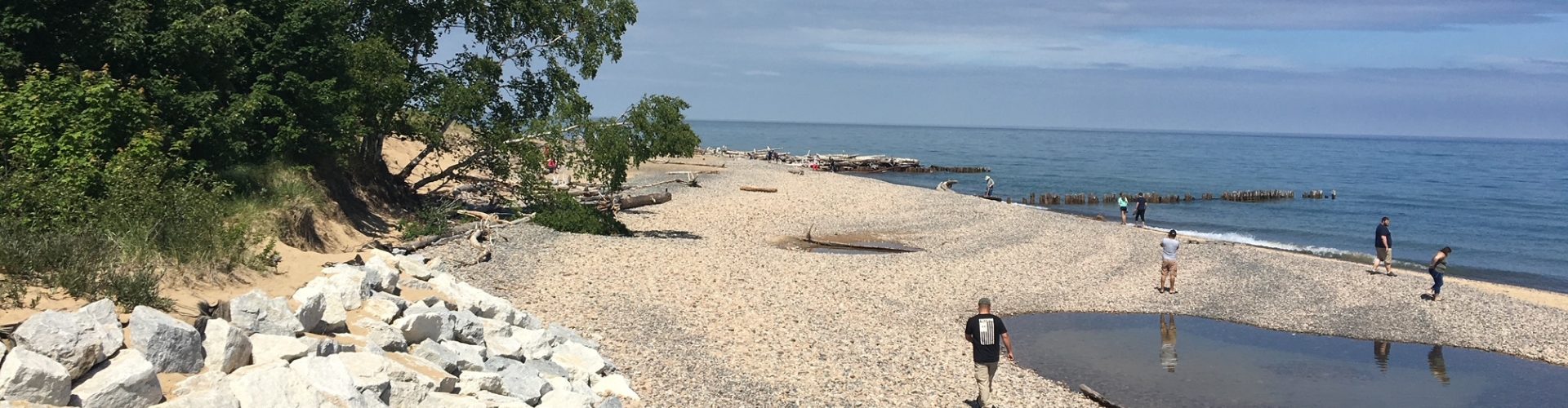
There is something unforgettable about standing on the shore of one of the Great Lakes. One moment the water is calm and crystal clear. The next, waves crash against the shoreline like the ocean. It is no surprise that millions of people visit Northern Michigan every year to experience these incredible lakes for themselves.
Together, Lakes Superior, Michigan, Huron, Erie, and Ontario make up the largest freshwater system on Earth. They shape the landscapes, communities, wildlife, and outdoor adventures that make Michigan such a special place to visit.
Whether you enjoy relaxing on a sandy beach, hiking along towering dunes, exploring historic lighthouses, or searching for colorful Petoskey stones, chances are the Great Lakes will be part of your Northern Michigan adventure.
Here are some fascinating facts about these remarkable lakes, along with ideas for places where you can experience them for yourself.
How Were the Great Lakes Formed?
If you could travel back more than 20,000 years, Northern Michigan would look dramatically different. Much of the region was buried beneath an enormous sheet of ice that was nearly a mile thick in some places.
As the climate slowly warmed, these massive glaciers began to melt and retreat. Their tremendous weight carved deep basins into the landscape. Meltwater from the glaciers filled these basins, creating the five Great Lakes we know today.
Today, the Great Lakes stretch nearly 1,000 miles from west to east. From the western shore of Lake Superior in Minnesota to the eastern end of Lake Ontario in New York, they form an interconnected freshwater system unlike anywhere else in the world.
The lakes continue to shape the region through changing water levels, powerful storms, sandy beaches, towering dunes, rocky cliffs, and thousands of miles of shoreline waiting to be explored.
Amazing Facts About All Five Great Lakes
They Hold More Than 20 Percent of the World’s Surface Fresh Water
One of the most impressive Great Lakes facts is the sheer amount of water they contain. Together, the five lakes hold more than 20 percent of all the surface fresh water on Earth.
Altogether, they contain more than 5,400 cubic miles of water. That is enough to supply drinking water for millions of people across the United States and Canada.
Michigan Touches Four of the Five Great Lakes
Michigan is the only state that borders four Great Lakes.
Lake Superior touches the Upper Peninsula.
Lake Michigan borders both the Upper and Lower Peninsulas.
Lake Huron stretches along much of Michigan’s eastern shoreline.
Lake Erie borders the southeastern corner of the state.
Only Lake Ontario does not touch Michigan.
Michigan Has More Freshwater Shoreline Than Any Other State
Michigan has about 3,300 miles of freshwater shoreline, more than any other state in the country. If you include the shorelines of islands, the total exceeds 11,000 miles.
Many of the state’s most scenic stretches of shoreline can be found right here in Northern Michigan, where visitors can discover quiet beaches, dramatic cliffs, charming harbor towns, and spectacular sunsets.
The Great Lakes Have More Than 35,000 Islands
Scattered across the five lakes are more than 35,000 islands.
The largest is Manitoulin Island in Lake Huron, which also happens to be the world’s largest freshwater island.
Northern Michigan is also home to beautiful island destinations, including Mackinac Island, Bois Blanc Island, Drummond Island, Beaver Island, Isle Royale, and the Manitou Islands near Sleeping Bear Dunes National Lakeshore.
Each island has its own unique history, outdoor recreation, and scenic beauty.
They Form the Largest Freshwater System on Earth
Together, the Great Lakes cover nearly 95,000 square miles.
The lakes are connected by rivers, channels, and the Straits of Mackinac, creating one enormous freshwater ecosystem that supports thousands of species of fish, birds, mammals, and plants.
For visitors, this means endless opportunities for boating, kayaking, fishing, paddleboarding, bird watching, and simply enjoying the incredible scenery.
If the Great Lakes Were Spread Across the Lower 48 States
Here is a fun way to picture just how much water these lakes contain.
If all the water in the Great Lakes were spread evenly across the contiguous United States, the entire Lower 48 would be covered in nearly 10 feet of water.
Fortunately, it stays right here, creating one of North America’s greatest natural treasures.
Ice Volcanoes Really Do Exist
One of the most unusual winter sights along the Great Lakes is something called an ice volcano.
When waves push water and slush beneath thick shoreline ice, pressure forces the water upward through small openings. Over time, cone shaped mounds of ice form along the shoreline, sometimes shooting water several feet into the air.
These icy formations appear during particularly cold winters and are one of Northern Michigan’s most unique seasonal attractions.
The Great Lakes Are One of North America’s Busiest Shipping Routes
More than 200 million tons of cargo move through the Great Lakes each year.
Massive freighters transport iron ore, limestone, grain, coal, and other products between ports throughout the United States and Canada.
Watching one of these enormous ships pass through the Soo Locks or beneath the Mackinac Bridge is an unforgettable experience.
The Great Lakes Have Their Own Floating Post Office
One of America’s most unique postal services operates right here on the Great Lakes.
The J. W. Westcott Company has been delivering mail directly to ships for more than 150 years. Today it remains the only floating ZIP Code in the United States.
Mail carriers meet freighters while both vessels are moving, transferring letters, packages, and supplies without either ship stopping.
Lake Sturgeon Are the Giants of the Great Lakes
Lake sturgeon are among the oldest fish species in North America.
These prehistoric fish can grow more than seven feet long, weigh hundreds of pounds, and live for well over 100 years.
Although they were once common throughout the Great Lakes, conservation efforts are helping restore their populations in many rivers and lakes across Michigan.
If you’re lucky, you may even spot one during seasonal spawning runs in Northern Michigan.
Quick Fact
The Great Lakes contain about 84% of North America’s surface fresh water.
Lake Superior, The Biggest and Boldest of the Great Lakes
There is something humbling about standing on the shore of Lake Superior. Its vast horizon, crystal clear water, and rugged shoreline often make visitors feel as though they are standing beside an inland ocean.
The Ojibwe people call it Gichigami, which means “great sea,” and after spending even a few minutes along its shoreline, it is easy to understand why.
From colorful sandstone cliffs and cascading waterfalls to historic shipwrecks and quiet beaches, Lake Superior offers some of the most spectacular scenery in Northern Michigan.
Did You Know?
Lake Superior Is the Largest Freshwater Lake by Surface Area
Covering more than 31,700 square miles, Lake Superior is the largest freshwater lake in the world by surface area. It stretches about 350 miles from west to east and reaches nearly 160 miles across at its widest point.
Standing on the shoreline, it is often impossible to see the opposite side.
It Holds About Half of the Great Lakes’ Water
Lake Superior contains roughly half of all the water found in the Great Lakes.
In fact, it holds so much water that it could contain all of Lakes Michigan, Huron, Erie, and Ontario, with room left over.
It Contains About 10 Percent of the World’s Surface Fresh Water
Lake Superior alone holds approximately 10 percent of all the surface fresh water on Earth.
Its incredible depth and volume make it one of the world’s most important freshwater resources.
The Water Is Surprisingly Cold
Even during the middle of summer, much of Lake Superior remains chilly.
Surface temperatures often stay in the 40s or 50s, especially farther from shore. Warm, sunny days can make the beaches inviting, but swimmers quickly discover why Superior has earned its reputation for cold water.
Shipwrecks Rest Beneath Its Waters
More than 500 known shipwrecks lie beneath Lake Superior, with many more believed to remain undiscovered.
One of the most famous is the Edmund Fitzgerald, which sank during a powerful November storm in 1975. The tragedy inspired Gordon Lightfoot’s well known song, “The Wreck of the Edmund Fitzgerald.”
Visitors can learn more about Great Lakes maritime history at the Great Lakes Shipwreck Museum at Whitefish Point, where the ship’s bell is on display.
Whitefish Point Is Known as the Graveyard of the Great Lakes
The stretch of shoreline between Munising and Whitefish Point has claimed hundreds of ships over the centuries.
Strong winds, sudden storms, rocky shoals, and a lack of natural harbors made this one of the most dangerous places for sailors on the Great Lakes.
Today, visitors can tour the lighthouse, museum, and nearby beaches while learning about the area’s fascinating maritime history.
Waves Can Rival the Ocean
During powerful autumn storms, waves on Lake Superior can exceed 25 feet.
These storms create dramatic scenery that draws photographers and storm watchers from across the Midwest. Watching the waves crash against the rocky shoreline is unforgettable, but it is always best to admire them from a safe distance.
Places to Experience Lake Superior
If Lake Superior is on your Northern Michigan bucket list, here are a few unforgettable places to visit.
- Pictured Rocks National Lakeshore
- Whitefish Point and the Great Lakes Shipwreck Museum
- Tahquamenon Falls State Park
- Grand Marais
- Munising
- Copper Harbor
- Porcupine Mountains Wilderness State Park
Each destination offers its own unique view of Michigan’s largest and wildest Great Lake.
Quick Fact
The Great Lakes holds more than 20% of the world’s surface fresh water.
Lake Michigan, Home to Sandy Beaches and Towering Dunes
While Lake Superior is known for its rugged wilderness, Lake Michigan welcomes visitors with wide sandy beaches, towering dunes, charming waterfront towns, and unforgettable sunsets.
Its shoreline stretches along both Michigan peninsulas, making it one of the state’s favorite destinations for summer vacations, scenic drives, and outdoor adventures.
Did You Know?
Lake Michigan Is the Only Great Lake Entirely Within the United States
Unlike the other four Great Lakes, Lake Michigan does not touch Canada.
Its shoreline belongs entirely to the United States, although its waters remain connected to Lake Huron through the Straits of Mackinac.
Lake Michigan and Lake Huron Are Technically One Lake
This surprises many visitors.
Because water flows freely through the Straits of Mackinac, Lakes Michigan and Huron remain at the same water level.
From a scientific perspective, they function as one enormous body of water, even though they have different names.
It Is Home to the World’s Largest Freshwater Sand Dunes
The eastern shoreline of Lake Michigan features the largest collection of freshwater sand dunes anywhere in the world.
Sleeping Bear Dunes National Lakeshore is perhaps the most famous example, where towering dunes rise hundreds of feet above the lake and offer breathtaking views in every season.
There Is an Underwater Crucifix in Northern Michigan
Just offshore in Little Traverse Bay near Petoskey sits one of Michigan’s most unique underwater landmarks.
The eleven foot crucifix was placed beneath the water in 1962 as a memorial to a local diver. Today, divers visit it throughout the year, while each winter, when ice conditions allow, a viewing hole is cut through the ice so visitors can look down at the statue.
Lake Michigan Has Its Own Pirate History
During Michigan’s logging boom, timber was often called “green gold.”
Some captains and criminals turned to stealing floating logs that were being transported across the lake. These so called timber pirates created a colorful chapter in Great Lakes history that is far less known than tales of pirates on the open ocean.
The Michigan Triangle Has Inspired Legends
A section of northern Lake Michigan has become known as the Michigan Triangle.
Over the years, stories have circulated about mysterious ship disappearances, missing aircraft, and unusual compass readings.
While there is no scientific evidence of anything supernatural, the legends continue to fascinate historians, divers, and visitors alike. Nearby, researchers have also discovered an ancient stone formation beneath the lake, adding another layer of intrigue to this fascinating part of Michigan.
Places to Experience Lake Michigan
Lake Michigan offers countless opportunities for adventure, relaxation, and spectacular scenery.
Some favorite destinations include:
- Sleeping Bear Dunes National Lakeshore
- Empire
- Frankfort
- Charlevoix
- Petoskey
- Ludington State Park
- Arcadia Bluffs
- Nordhouse Dunes Wilderness Area
- Beaver Island
Whether you spend the day climbing dunes, searching for Petoskey stones, watching the sunset from a quiet beach, or exploring one of the many charming harbor towns, Lake Michigan offers unforgettable experiences for visitors of every age.
Quick Fact
More than 6,000 shipwrecks are believed to rest beneath the Great Lakes, although many have never been found.
Lake Huron, Shipwrecks, Sunrises, and Hidden Wonders
Lake Huron is often overshadowed by its larger neighbors, but it may be the Great Lake with the most surprises. Its shoreline is filled with quiet beaches, historic lighthouses, hidden coves, and some of the best preserved shipwrecks in North America.
The sunrise over Lake Huron is worth an early alarm, and its clear waters invite visitors to paddle, dive, fish, and explore.
Did You Know?
Lake Huron Has the Longest Shoreline of Any Great Lake
Thanks to its thousands of islands and winding coastline, Lake Huron has the longest shoreline of all five Great Lakes, stretching more than 3,800 miles.
Much of Michigan’s eastern shoreline borders Lake Huron, offering countless opportunities to discover peaceful beaches and charming waterfront communities.
It Is Home to More Than 30,000 Islands
Lake Huron contains more islands than any other Great Lake.
The largest is Manitoulin Island in Ontario, which is also the world’s largest freshwater island.
Closer to Northern Michigan, visitors can explore Drummond Island, Bois Blanc Island, and Mackinac Island, each offering its own unique scenery and outdoor adventures.
More Than 1,000 Shipwrecks Rest Beneath Lake Huron
Storms, fog, rocky reefs, and heavy shipping traffic have claimed hundreds of vessels over the centuries.
Today, many of these remarkably preserved wrecks attract divers from around the world.
Even if you are not a diver, you can learn their stories through museums, glass bottom boat tours, and maritime exhibits along the shoreline.
Thunder Bay Is America’s Only Freshwater National Marine Sanctuary
Near Alpena, the Thunder Bay National Marine Sanctuary protects nearly 4,300 square miles of Lake Huron.
Often called Shipwreck Alley, the sanctuary preserves dozens of historic shipwrecks that can be explored by scuba divers, snorkelers, kayakers, or aboard glass bottom boat tours.
The Great Lakes Maritime Heritage Center in Alpena is an excellent place to begin your visit, with interactive exhibits that bring Great Lakes history to life.
Ancient Sinkholes Reveal Clues About Early Earth
One of the most remarkable discoveries beneath Lake Huron has nothing to do with shipwrecks.
Scientists have discovered underwater sinkholes that contain unique microbes living in conditions similar to those found on Earth billions of years ago.
Studying these organisms may help researchers better understand how life first developed on our planet.
An Ancient Hunting Site Lies Beneath the Lake
In 2014, archaeologists discovered a nearly 9,000 year old hunting site beneath Lake Huron.
Long before rising lake levels covered the area, early hunters built stone drive lanes that guided migrating caribou toward waiting hunters.
Today, these remarkably preserved structures remain hidden beneath the lake, offering a fascinating glimpse into life thousands of years before the Great Lakes looked as they do today.
Turnip Rock Is One of Michigan’s Most Unique Landmarks
One of the most photographed natural features along Lake Huron is Turnip Rock near Port Austin.
This unusual rock formation has been sculpted by wind and waves into the shape of an oversized turnip.
The only way to reach it is by kayak or paddleboard, making it one of Michigan’s most memorable paddling destinations.
Places to Experience Lake Huron
If you are planning a Lake Huron adventure, consider visiting:
- Thunder Bay National Marine Sanctuary
- Great Lakes Maritime Heritage Center
- Turnip Rock
- Alpena
- Presque Isle
- Harrisville State Park
- Mackinac Island
- Cheboygan State Park
Each destination showcases a different side of Lake Huron, from maritime history to peaceful beaches and scenic paddling routes.
Quick Fact
The Great Lakes shoreline stretches nearly 10,000 miles, which is longer than the distance across the continental United States.
Lake Erie, The Shallowest Great Lake
Although Lake Erie receives less attention from many Northern Michigan travelers, it has played an important role in the region’s history, ecology, and recreation.
Its shallow waters warm quickly each summer, making it one of the most productive fisheries in North America.
Did You Know?
Lake Erie Is the Shallowest Great Lake
With an average depth of just over 60 feet, Lake Erie is much shallower than the other Great Lakes.
Its shallow depth allows the water to warm more quickly during the summer, creating ideal conditions for fish and wildlife.
It Freezes More Often Than the Other Great Lakes
Because it is relatively shallow, Lake Erie often develops extensive ice cover during the winter.
Some years, large portions of the lake freeze almost completely.
It Is Known as the Walleye Capital of the World
Lake Erie supports one of the world’s best walleye fisheries.
Anglers travel from across North America hoping to catch trophy fish in its productive waters.
Lake Erie Has Its Own Legendary Lake Monster
Like several other Great Lakes, Lake Erie has inspired local folklore.
For more than 200 years, people have reported sightings of a mysterious creature known as Bessie.
Descriptions vary, but the stories have become part of the colorful history and legends surrounding the Great Lakes.
Whether fact or folklore, Bessie continues to capture imaginations.
The Shores Support a Thriving Wine Region
The climate along Lake Erie creates ideal growing conditions for grapes.
Vineyards stretch across portions of Ohio, Pennsylvania, New York, and Ontario, producing award winning wines and making this one of North America’s most important grape growing regions.
Quick Fact
Michigan has more lighthouses than any other state, with more than 120 guiding ships along its Great Lakes shoreline.
Lake Ontario, Gateway to the Atlantic
Lake Ontario is the smallest Great Lake by surface area, but it plays a vital role in connecting the Great Lakes to the Atlantic Ocean through the St. Lawrence River.
It has a rich history, beautiful island landscapes, and plenty of fascinating stories.
Did You Know?
It Is the Final Great Lake
Water from all four upstream Great Lakes eventually flows into Lake Ontario before continuing through the St. Lawrence River and eventually reaching the Atlantic Ocean.
It Is Home to the Thousand Islands
Near the outlet of the St. Lawrence River lies the famous Thousand Islands region.
Despite its name, the area actually contains nearly 2,000 islands, ranging from tiny rocky outcrops to islands with castles, cottages, and forests.
Ontario Was Named After the Lake
The name Ontario comes from an Iroquoian word often translated as “beautiful lake” or “great lake.”
Later, Canada’s most populous province took its name from the lake.
Lake Ontario Has Its Own Legendary Creature
Like Lake Erie, Lake Ontario has inspired stories of an unusual lake creature.
Historical accounts dating back hundreds of years describe a long necked animal occasionally appearing above the water.
While there is no scientific evidence supporting these sightings, the legend remains part of Great Lakes folklore.
There Is Even an Ontario Lake on Saturn’s Moon
One of the most surprising Great Lakes facts reaches far beyond Earth.
Scientists named a large lake on Saturn’s moon Titan, Ontario Lacus, after Lake Ontario.
It is a reminder that one of North America’s Great Lakes has inspired discoveries that extend all the way into our solar system.
More Than Just Five Lakes
Each Great Lake has its own personality.
Lake Superior inspires awe with its rugged beauty.
Lake Michigan welcomes visitors with sandy beaches and towering dunes.
Lake Huron combines history, shipwrecks, and peaceful shorelines.
Lake Erie offers world class fishing and rich wildlife.
Lake Ontario serves as the final gateway connecting the Great Lakes to the Atlantic Ocean.
Together, they create one of the world’s greatest freshwater treasures and one of the biggest reasons so many people fall in love with Northern Michigan.
Experience the Great Lakes for Yourself
Reading about the Great Lakes is one thing. Standing on their shores is something entirely different.
Every season offers a new way to experience these incredible waters. Summer brings beach days, kayaking, and lighthouse tours. Fall transforms the shoreline with colorful forests and dramatic waves. Winter creates sparkling ice formations and peaceful snow covered beaches. Spring welcomes migrating birds, rushing waterfalls, and fresh adventures.
Whether you have a weekend or a full week to explore, Northern Michigan offers countless opportunities to experience the beauty and history of the Great Lakes.
Here are a few destinations that deserve a spot on your travel list.
Visit Sleeping Bear Dunes National Lakeshore
Few places capture the beauty of Lake Michigan quite like Sleeping Bear Dunes National Lakeshore.
Climb towering sand dunes, relax on quiet beaches, hike scenic trails, or drive the Pierce Stocking Scenic Drive for unforgettable views of Lake Michigan.
If you have time, take a ferry to South Manitou Island or North Manitou Island to discover historic lighthouses, shipwrecks, and miles of peaceful hiking trails.
Explore Whitefish Point
Located along the southeastern shore of Lake Superior, Whitefish Point is one of Michigan’s most historic destinations.
Visit the Great Lakes Shipwreck Museum, tour the lighthouse, walk the beach, and learn why this stretch of shoreline became known as the Graveyard of the Great Lakes.
During migration season, Whitefish Point is also one of Michigan’s best bird watching destinations.
Discover Thunder Bay National Marine Sanctuary
If you have ever wondered what lies beneath the surface of the Great Lakes, Alpena is the place to find out.
The Great Lakes Maritime Heritage Center features interactive exhibits that tell the stories of the ships and sailors that shaped Great Lakes history.
During the summer, glass bottom boat tours allow visitors to view several historic shipwrecks without getting wet.
Cross the Mighty Mackinac Bridge
Few experiences are more memorable than driving across the Mackinac Bridge.
Connecting Michigan’s Upper and Lower Peninsulas, the bridge spans the Straits of Mackinac, where Lakes Michigan and Huron meet.
Whether you are heading north or returning home, the views are spectacular in every season.
Visit Michigan’s Lighthouses
More than 120 lighthouses stand along Michigan’s Great Lakes shoreline.
Some are open for tours, while others are perfect for photography, picnics, or simply enjoying the view.
Each one tells a story of sailors, storms, and the communities that depended on them.
Hunt for Petoskey Stones and Great Lakes Fossils
Every Great Lakes beach tells a story, and sometimes you can take a small piece of that story home.
As you stroll along the shoreline, look for the distinctive honeycomb pattern of a Petoskey stone, colorful pudding stones, smooth Charlevoix stones, or ancient fossils that date back hundreds of millions of years.
The thrill of spotting one among thousands of ordinary stones never gets old, making beachcombing one of the most relaxing and rewarding activities in Northern Michigan.
Final Thoughts
The Great Lakes are much more than five large bodies of water.
They have shaped Michigan’s history, influenced its culture, supported its wildlife, and created some of the most beautiful landscapes in North America.
From the towering cliffs of Lake Superior to the sandy beaches of Lake Michigan and the historic waters of Lake Huron, every shoreline offers something new to discover.
Whether you are planning your very first trip to Northern Michigan or returning for another adventure, the Great Lakes have a way of calling you back again and again.
So pack your camera, lace up your hiking boots, and head for the water. Your next Northern Michigan adventure is waiting along the shoreline.
